

CPD courses for nurses and midwives,
built around The Code.
Ethics and Professionalism for nurses and midwives, plus Reflection for your revalidation accounts, and our Probity, Boundaries and Fitness to Practise libraries. Every course is mapped to The Code (2018).
What brings you here today?
Ethics & Professionalism for Nurses & Midwives
Ethics & Ethical Standards for Nurses & Midwives
What it covers
For Nurses and midwives wanting ethical reasoning built for nursing and midwifery practice
Consent, capacity and the Montgomery standard applied to nursing and midwifery care
Confidentiality, the professional duty of candour, and probity
A structured method for ethical dilemmas, applied to end-of-life nursing care
Professionalism & Professional Standards for Nurses & Midwives
What it covers
For Nurses and midwives wanting the standing, conduct and competence side of The Code, done properly
Competence, safe delegation to healthcare assistants and students, and safe staffing
Workplace culture, raising concerns properly, and fair leadership
Everyday conduct, online conduct, and wellbeing as a professional duty
Every course relevant to NMC-registered nurses & midwives
Fitness to Practise, Probity & Honesty, Professional Boundaries and the shared Professionalism courses are all live. Filter by topic below.
Reflection: Learning from Your Practice
For Nurses and midwives who need to write the five reflective accounts required for NMC revalidation
- Produce structured reflections linked to The Code
- Use Gibbs’ cycle to write accounts that show learning, not just description
Fitness to Practise: What You Need to Know
For Nurses and midwives who want to understand the NMC process before a concern ever reaches them
- How a regulator typically triages, investigates and refers concerns to a fitness to practise panel
- What a regulator needs to see at each stage to resolve or close a case
Insight: Understanding Your Mistakes
For Nurses and midwives who want to understand what insight means to a regulator, before it is ever tested
- Apply the four-pillar framework fitness to practise panels use in every case
- Write a reflective account that holds up at a hearing or at revalidation
- Avoid the six reflection failures that undermine well-intentioned accounts
Remediation: Demonstrating Change
For Nurses and midwives who want to understand what evidenced change looks like, before they ever need it
- Build a remediation plan connected directly to the root cause
- Gather the specific evidence a panel looks for, not just good intentions
How to Ensure a Similar Mistake Won’t Happen Again
For Nurses and midwives who want to show systemic learning, not just a one-off fix
- Identify the root-cause conditions behind a recurring type of error
- Show a panel or employer that the fix addresses the system, not just the incident
How to Deal with a Complaint
For Nurses and midwives who want to handle a complaint well before one is made
- Understand each stage of a complaints process and what is expected at each
- Draft an honest, well-judged response that does not make things worse
How to Avoid a Complaint
For Nurses and midwives wanting to reduce the risk of a complaint before one ever happens
- Recognise the communication patterns behind most complaints
- Apply practical changes to how you handle difficult conversations
Duty of Candour & Openness
For Nurses and midwives wanting to understand both the statutory and the professional duty of candour
- The legal test for a notifiable safety incident
- Apologising honestly without conceding legal fault
Gifts, Hospitality & Conflicts of Interest
For Nurses and midwives wanting clarity on gifts from patients, sponsored training and secondary work
- How to judge whether an interest may affect, or be seen to affect, your judgement
- Two complete worked cases, not just the theory
Probity & Honesty in Practice
For Nurses and midwives wanting to understand why dishonesty is treated differently from a competence concern
- The common forms dishonesty takes in clinical practice
- Two complete worked cases, including pressure from a colleague
Financial Integrity & Probity
For Nurses and midwives wanting clarity on expenses, secondary income and financial honesty
- Fraud patterns, undeclared secondary income and how it begins
- Why the amount involved does not change how seriously it is treated
Rebuilding Trust with Patients & Regulators
For Nurses and midwives who want to understand how trust is rebuilt after a concern
- The practical steps to rebuilding trust after a concern is resolved
- What patients, employers and regulators look for over time
Professional Boundaries in Health and Social Care
For Nurses and midwives wanting clarity on the line between professional care and a relationship that exploits trust
- How regulators think about power imbalance and trust
- Boundaries with colleagues, not just patients
Ethical Boundaries with Patients & Colleagues
For Nurses and midwives who care for people they already know, or who are navigating favouritism
- Treating family, friends and acquaintances, and when to step back
- Favouritism, with no romantic element required
Social Media & Digital Professional Boundaries
For Nurses and midwives wanting clarity on where the professional line sits online, personal accounts included
- Where the professional line sits on personal accounts
- The anonymisation misconception most professionals hold
Privacy, Consent & Chaperone
For Nurses and midwives who perform, supervise or act as a chaperone for intimate care and examinations
- The consent requirements that apply to intimate care and examinations
- What counts as fulfilling the chaperone role
Professionalism in Documentation
For Nurses and midwives wanting records that protect patients and stand up to scrutiny
- The line between an error and falsification, with a case worked in full
- How to add a late entry correctly
Effective Communication in Practice
For Nurses and midwives wanting safer handover and stronger communication with patients and colleagues
- Why handover is the highest-risk moment, with a case worked in full
- SBAR, and communicating with patients as well as colleagues
Teamwork & Collaboration
For Nurses and midwives wanting to work well across teams and raise concerns safely
- What bullying looks like, and why concerns get harder to raise with seniority
- What protects you when you raise a concern, and how to escalate
Clinical Competence & Patient Safety
For Nurses and midwives wanting to maintain competence and recognise their limits
- Recognising the limits of your competence and seeking supervision
- How regulators weigh evidence of remediation
Dignity & Non-Discrimination
For Nurses and midwives wanting to apply The Code’s duty to treat people with kindness, respect and compassion
- Dignity and non-discrimination in everyday care
- What a discrimination concern looks like when it reaches a regulator
What the NMC asks for every three years
How many CPD hours do nurses and midwives need for revalidation?
35 hours of CPD in the three years before your renewal date, including 20 hours of participatory learning. Our self-paced courses add to your total hours. Whether an activity meets the NMC’s definition of participatory learning is something to check against the NMC’s own guidance.
Revalidation is how nurses, midwives and nursing associates renew their registration. It is built around The Code, so CPD that is mapped to The Code gives your reflective accounts and your confirmation conversation something concrete to rest on.
- 450practice hours (900 if you are registered as both a nurse and a midwife)
- 35hours of CPD, including 20 hours of participatory learning
- 5pieces of practice-related feedback
- 5written reflective accounts on The Code
- 1reflective discussion with another NMC registrant, then confirmation
Requirements are summarised from the NMC’s published revalidation guidance. Check nmc.org.uk for the current version and for how your own situation applies.
What’s going on for you?
Four common situations nurses and midwives preparing for routine CPD or revalidation are in.
I’m preparing for NMC revalidation
Revalidation asks for 35 hours of CPD and five written reflective accounts. Ethics and Professionalism give you substantive learning across The Code, and Reflection helps you turn it into accounts your confirmer can read.
My Trust or practice has asked for specific training
Candour, record-keeping, boundaries or communication training requested as part of an employer or governance requirement.
I want a refresher on The Code
The Code’s own wording, applied to nursing and midwifery decisions, not a generic ethics framework relabelled.
I want to build reflective practice as a habit
An ongoing discipline that strengthens over successive revalidation cycles, not a one-off exercise before the deadline.
What makes our NMC courses different from generic CPD
Built against The Code (2018)
Every lesson maps to one of The Code’s four themes and cites its wording, not a generic ethics framework relabelled for nursing and midwifery.
Written for nursing and midwifery
Examples, standards and scenarios are drawn from nursing and midwifery practice, including delegation, staffing and care of vulnerable people.
Worked cases, not abstract theory
Courses include multi-step cases that tie the principles to an actual clinical or workplace decision.
A certificate that names what you completed
Issued only on passing the final assessment at 80%. Suitable evidence for your revalidation portfolio.
CrownEthics is an Approved CPD Provider
CrownEthics is a CPD Group Approved Provider, Provider #791056, listed on The CPD Group’s public register. This relates to our status as a provider only.
Verify our provider status →- Approved CPD Provider #791056, publicly listed
- This confirms provider status only
- Course certificates are issued by CrownEthics
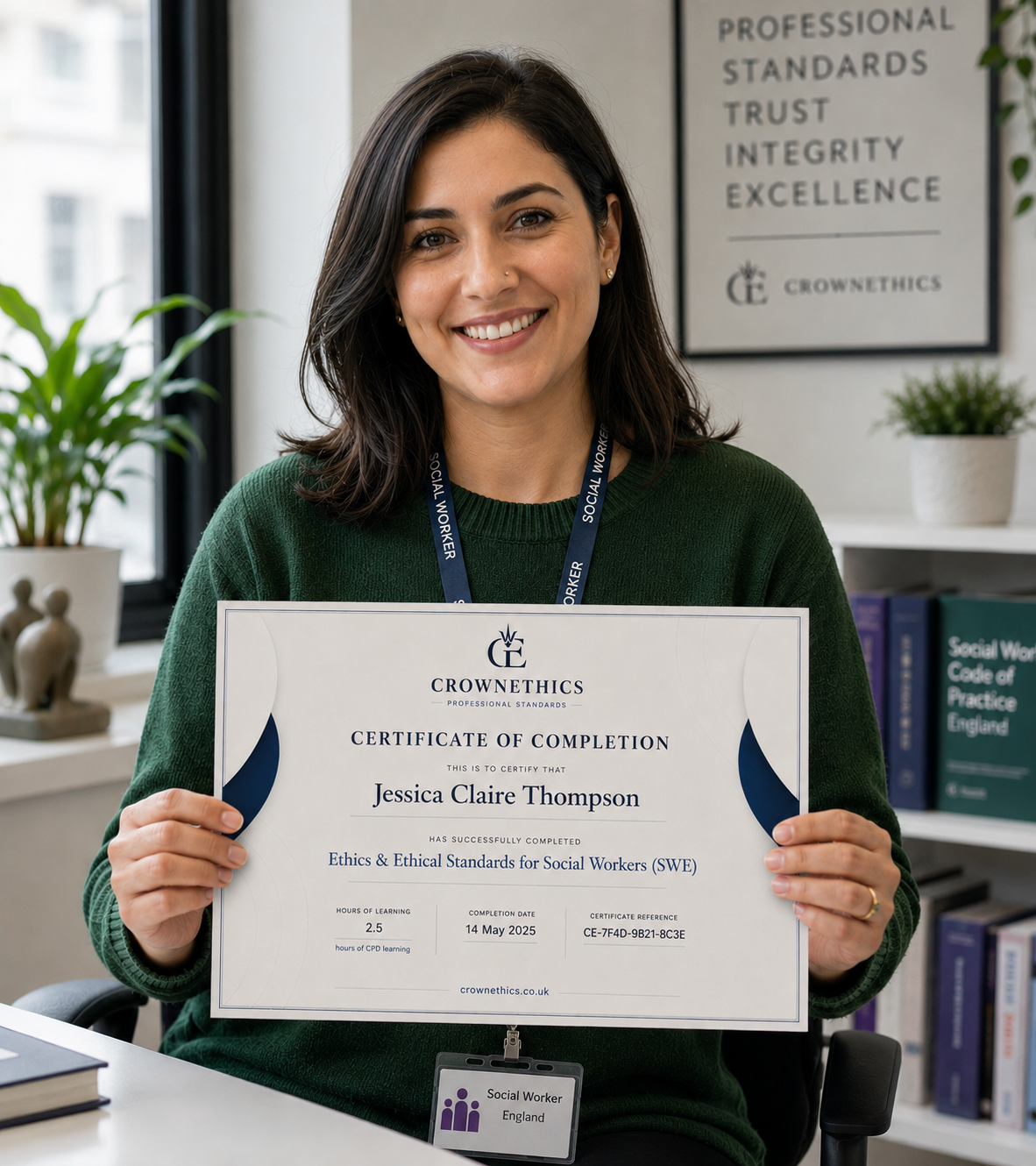
A certificate that shows exactly what you completed
Every CrownEthics certificate names the specific course, the CPD hours, the date and a unique reference number. It is a CrownEthics certificate of completion, useful evidence for your revalidation portfolio.
- Course name and CPD hours stated clearly
- Unique certificate reference number
- Issued only after passing the final assessment
- Downloadable and yours to keep
Buy any 3, 5, or 10 courses, your choice, any area
No fixed packages. Pick exactly what is relevant, and the discount applies automatically at checkout.
From choosing a course to holding your certificate
A straightforward process, whether you are building a revalidation portfolio or responding to a live concern.
Choose your courses
Use the situation guide above, or browse the full catalogue and add whatever is relevant.
Complete at your own pace
Fully online, available immediately after enrolling. One sitting or several.
Pass the final assessment
Score 80% or higher to unlock your certificate. Retakes are unlimited.
Download your certificate
Ready immediately, showing the course title, CPD hours and your name.
NMC CPD & revalidation — common questions
The questions nurses and midwives most often ask about this curriculum.
Do these courses count towards NMC revalidation?
Yes, they count towards your 35 hours of CPD, and each course gives you a certificate and a clear record of hours. The NMC also requires 20 of those hours to be participatory learning, which involves interaction with other professionals. Check the NMC’s guidance on how your own activities meet that definition.
How many CPD hours do nurses and midwives need?
35 hours in the three years before renewal, including 20 hours of participatory learning, alongside 450 practice hours, five pieces of practice-related feedback, five written reflective accounts and a reflective discussion.
Should I take Ethics or Professionalism first?
Either stands alone. If a specific ethical question such as consent, confidentiality or candour is on your mind, start with Ethics. If your situation is more about competence, delegation, culture or conduct, start with Professionalism. Together they cover all four themes of The Code.
Can these courses help with my reflective accounts?
The Reflection course is built for exactly this. It shows how to structure an account, link it to The Code and show what changed in your practice. The accounts themselves must be your own.
What’s the difference between the Probity & Honesty courses and Ethics?
Ethics covers the breadth of The Code. The Probity & Honesty courses go deeper into specific areas: candour, gifts and conflicts, dishonesty, financial integrity and rebuilding trust.
Are these courses suitable if I’m not facing any concern?
Yes. Most nurses and midwives who take them are building CPD for revalidation or want a refresher on The Code. If you are facing a live concern, our NMC Remediation courses are built for that.
Is there an assessment for each course?
Yes. Each course has short knowledge checks plus a final assessment, with an 80% pass mark to unlock your certificate. Retakes are unlimited.
Can my Trust or practice enrol several people at once?
Yes. We offer team access and bulk pricing, with an individual certificate issued to everyone who completes each course. Contact us for organisation-level enrolment.
We’ll email you when it launches
Usually with an early-access discount for people on the list.