

CPD courses for social workers,
including those facing a Social Work England investigation.
Ethics and Professionalism for Social Work England-registered social workers across children's and adult services, plus our full Fitness to Practise series, built around the six Professional Standards, every course reviewed by qualified professionals. More courses across Probity, Professionalism and Boundaries are on the way.
What brings you here today?
Ethics & Professionalism for Social Workers
Ethics & Ethical Standards for Social Workers (Social Work England)
What it covers
For Social workers wanting genuine ethical reasoning built around the standards' actual first-person framing, not a generic professional ethics course
Genuine partnership, recognising people as experts in their own lives
Real trust and confidence, confidentiality, and role clarity
Safety, respect, and professional integrity, in and outside work
Professionalism & Professional Standards for Social Workers (Social Work England)
What it covers
For Social workers wanting the standing-practice side of the standards, evidence, delegation, and raising concerns, done properly
Accountable, evidence-based decisions that guard against bias
Genuine collaboration, appropriate delegation, and records that hold up
Raising concerns properly, about a colleague, your employer, or yourself
Every course relevant to Social Work England-registered social workers
Fitness to Practise is live now and regulator-neutral. Probity & Honesty, Professionalism, and Boundaries courses are in development, select a tab to see what's coming.
Fitness to Practise — What You Need to Know
For Social Work England-registered social workers who want to understand the process before or during an investigation
- How a regulator typically triages, investigates and refers concerns to a fitness to practise panel
- What a regulator needs to see at each stage to resolve or close a case
Insight — Understanding Your Mistakes
For Doctors facing a GMC concern, at revalidation, or wanting to understand what the MPTS assesses most
- Apply the four-pillar framework fitness to practise panels use in every case
- Write a reflective account that holds up at a hearing or at appraisal
- Avoid the six reflection failures that undermine even well-intentioned accounts
Reflection — Learning from Your Practice
For Doctors building revalidation portfolios or required to evidence reflective practice
- Produce structured reflections that satisfy appraisers and supervisors
- Use Gibbs' cycle to write accounts that demonstrate genuine learning
Remediation — Demonstrating Change
For Doctors who need to show a regulator or employer that genuine change has happened
- Build a remediation plan connected directly to the actual root cause
- Gather the specific evidence a panel actually looks for, not just good intentions
How to Ensure a Similar Mistake Won't Happen Again
For Doctors who want to demonstrate systemic learning, not just a one-off fix
- Identify the root-cause conditions behind a recurring type of error
- Show a panel or employer that the fix addresses the system, not just the incident
How to Deal with a Complaint
For Doctors navigating an active complaint, from a patient or through their employer
- Understand each stage of a complaints process and what's expected at each
- Draft an honest, well-judged response that doesn't make things worse
How to Avoid a Complaint
For Doctors wanting to reduce the risk of a complaint before one ever happens
- Recognise the communication patterns behind most concerns raised
- Apply specific, practical changes to how you handle difficult conversations
What's actually going on for you?
Four common situations, and exactly which courses address each one directly.
I've received a letter from Social Work England
Understand what's actually happening, what the investigation process looks like, and how to start building genuine insight and evidenced change.
A person's wishes and a genuine risk factor are pulling apart
Work through balancing rights and risk properly, when a capacitous person's clearly expressed choice sits against real, assessed concern.
I need to raise a concern, about a colleague, my employer, or myself
Work through reporting properly, whatever form the concern takes, and what full cooperation genuinely requires if the investigation concerns your own conduct.
I'm delegating or working across a genuinely multi-disciplinary team
Delegate appropriately while remaining genuinely accountable, and work through real collaboration with health, education, and housing colleagues.
I'm just preparing for appraisal or registration renewal
No active concern, just genuine, substantive CPD covering all six Professional Standards between our Ethics and Professionalism courses.
What makes our Social Work England courses different from generic CPD
Built directly against the six Professional Standards
Every lesson maps to a specific standard and keeps the standards' genuine first-person framing, "as a social worker, I will," using real scenarios across children's and adult services, not a generic professional ethics course with the job title changed.
Reviewed by qualified professionals
Every course is read in full for clinical accuracy, regulatory alignment, and real-world applicability before it goes live.
Genuine worked cases, not abstract theory
Every module closes with a real, multi-step case that ties the domain's principles to an actual clinical or workplace decision.
Certificate that means something
Issued only on passing the final assessment at 80%. Suitable for appraisal and revalidation portfolios.
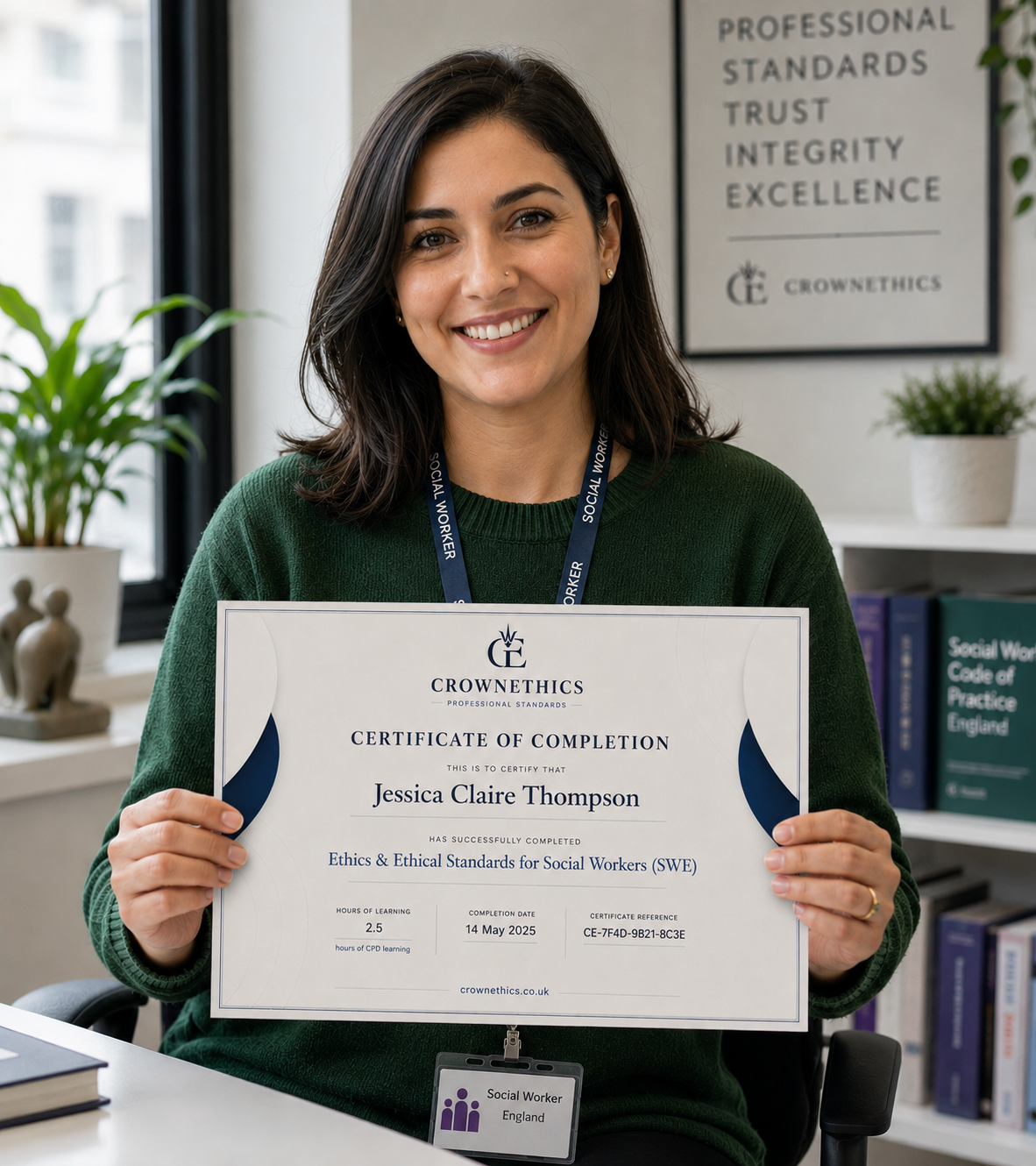
A certificate that shows exactly what you completed
No generic "attendance" certificate. Every CrownEthics certificate names the specific course, the exact CPD hours completed, the date, and a unique reference number, real, checkable evidence for your registration renewal or appraisal portfolio, not just a nice PDF.
- Course name and exact CPD hours stated clearly
- Unique certificate reference number
- Issued only after passing the final assessment
- Downloadable and yours to keep, permanently
Buy any 3, 5, or 10 courses, your choice, any area
No fixed packages. Pick exactly what's relevant, and the discount applies automatically at checkout.
From choosing a course to holding your certificate
A straightforward process, whether you're building an appraisal portfolio or responding to a live concern.
Choose your courses
Use the concern-type filter above, or browse the full catalogue and add whatever's relevant.
Complete at your own pace
Fully online, available immediately after enrolling. One sitting or several.
Pass the final assessment
Score 80% or higher to unlock your certificate. Retakes are unlimited.
Download your certificate
Ready immediately, showing the course title, CPD hours, and your name.
Social Work England courses — common questions
The questions Social Work England-registered social workers most commonly search or ask about this curriculum.
I've received a letter from Social Work England — what should I do first?
Contact your defence organisation or professional indemnity provider immediately if you haven't already. Alongside their advice, beginning relevant CPD is a genuine, proactive step, but it doesn't replace professional legal or regulatory advice specific to your case.
Will completing these courses help my case?
They'll give you a genuine, documented account of professional learning relevant to the concern raised, useful supporting evidence for your own remediation statement or appraisal portfolio. We can't promise a specific outcome from your case, and we're not a substitute for advice from your defence organisation or solicitor.
What's the difference between a concern, complaint, and formal investigation?
A concern or complaint is typically Social Work England's initial review of information they've received. Not every concern becomes a formal fitness to practise investigation, many are resolved or closed at an early stage. If yours has progressed to a formal investigation, your defence organisation can explain exactly where you are in the process and what happens next.
Do these courses count towards Social Work England CPD requirements?
Yes. Every course provides documented CPD hours with a certificate on completion, suitable evidence for your revalidation portfolio.
Does this apply equally to children's and adult services?
Yes. The six Professional Standards apply equally across every setting, and our courses use scenarios and worked cases drawn from both children's and adult services, not one setting with the other assumed to follow along.
How quickly can I start, and how fast can I get a certificate?
Access is immediate after enrolling. Each course takes roughly 1.5 to 2.5 hours depending on the course, so you can realistically complete one and hold a certificate the same day.
What does Social Work England actually mean by "insight"?
Insight means genuinely understanding what went wrong, your own part in it, who was affected, and demonstrating concrete change, not simply expressing regret. Our Insight — Understanding Your Mistakes course works through this specific framework in depth, since it's consistently the factor fitness to practise panels weigh most heavily.
Should I take Ethics or Professionalism first?
Either stands alone. If a specific ethical dilemma, consent, confidentiality, honesty, is on your mind, start with Ethics. If your situation is more about competence, culture, or conduct, start with Professionalism. Most Social Work England-registered social workers get the most value from both, since together they cover all six Professional Standards.
I work across more than one regulator, is this still relevant?
Yes. Fitness to Practise, Probity & Honesty, Professionalism, and Boundaries courses on this page are regulator-neutral, built for the standards every UK regulator shares. If you're also registered with the GMC, NMC, GDC, HCPC, or GPhC, that regulator has its own Ethics and Professionalism pair alongside this same shared library.
Are these courses suitable if I'm not currently facing any concern?
Absolutely. Most Social Work England-registered social workers who take these courses are building CPD for registration renewal, preparing for an appraisal, or simply want a genuine refresher on the Professional Standards, not responding to an active case.
Is there an assessment for each course?
Yes. Each course has short knowledge checks plus a final assessment, requiring 80% to pass and unlock your certificate. Retakes are unlimited.
How is CrownEthics different from other Social Work England course providers?
Every course is built directly against the six Professional Standards, kept in their genuine first-person framing, using real scenarios across children's and adult services, not a generic professional ethics course with the job title changed, and reviewed in full by qualified professionals before publishing. We'd rather have fewer, genuinely substantive courses than a large catalogue of thin ones.
Can my organisation enrol multiple staff at once?
Yes. We offer team access and bulk pricing for NHS Trusts, private providers, and independent practices, with an individual certificate issued for everyone who completes each course. Contact us for organisation-level enrolment, or visit CrownEthics to see everything we offer across every regulator.
We'll email you when it launches
Usually with an early-access discount for people on the list.