

Ethics & Ethical Standards CPD Courses for UK Healthcare Professionals
Every UK regulator sets its own Ethics & Ethical Standards, so we built a separate, regulator-specific course for each. Find your regulator below, or jump straight to your course.
CPD Accredited Provider · #791056Ethics & Ethical Standards, by regulator
Each course is built around your regulator's own published standards, not a generic ethics framework relabelled six times.
Ethics & Ethical Standards for Doctors (GMC)
For Doctors wanting genuine ethical reasoning grounded in Good Medical Practice 2024
- Consent, capacity and the Montgomery standard applied to real clinical decisions
- Confidentiality, the professional duty of candour, and probity
Ethics & Ethical Standards for Nurses & Midwives (NMC)
For Nurses and midwives wanting ethical reasoning grounded in the NMC Code
- Consent, capacity, and patient autonomy in nursing and midwifery practice
- Confidentiality, candour, and professional boundaries under the Code
Ethics & Ethical Standards for Dentists & Dental Care Professionals
For Dentists and the wider dental team wanting ethical reasoning grounded in Standards for the Dental Team
- Consent, capacity, and patient-centred care across the dental team
- Confidentiality, candour, and raising concerns properly
Ethics & Ethical Standards for HCPC-Registered Professionals
For HCPC registrants across all 15 professions wanting ethical reasoning grounded in the Standards of Conduct
- Consent, capacity, and service-user autonomy across HCPC professions
- Confidentiality, candour, and professional boundaries
Ethics & Ethical Standards for GPhC-Registered Pharmacy Professionals
For Pharmacists and pharmacy technicians wanting ethical reasoning grounded in Standards for Pharmacy Professionals
- Person-centred care, professional judgement, and candour
- Confidentiality and managing conflicts of interest in pharmacy practice
Ethics & Ethical Standards for Social Workers (Social Work England)
For Social workers wanting ethical reasoning grounded in the Professional Standards
- Autonomy, capacity, and person-centred practice in social work
- Confidentiality, candour, and professional boundaries
The same rigour, applied to your actual profession
Every regulator's course covers the same real ground, consent, confidentiality, candour, and ethical decision-making, worked through your regulator's own published standards, not a generic principles list.
Consent & capacity
Applied to real, profession-specific scenarios, not abstract theory.
Confidentiality
Including when and how disclosure is genuinely justified.
Candour & honesty
The professional duty to be open, and how it interacts with probity.
Ethical decision-making
A structured method for genuine dilemmas, not just definitions.
Your regulator's standards
Mapped directly to the actual published code you're held to.
Worked case studies
Real, multi-step scenarios specific to your profession.
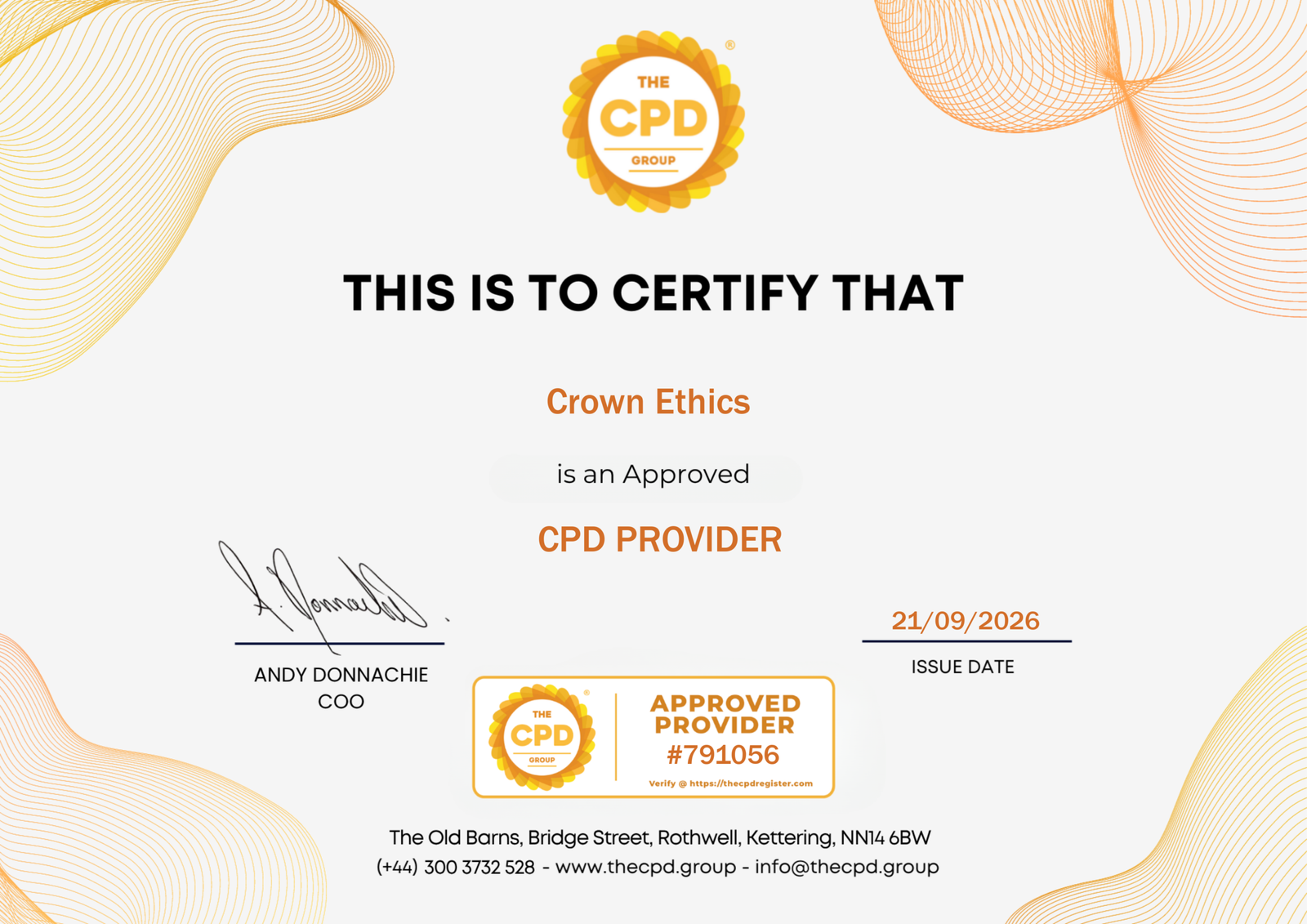
We're an accredited CPD provider
CrownEthics is a CPD Group Approved Provider, Provider #791056. That's not a claim we're making about ourselves, it's independently verifiable in seconds on the CPD Group's own public register, no need to take our word for it.
- Independently accredited by The CPD Group
- Provider #791056, publicly listed and searchable
- Every course reviewed against the same accredited standard
Ethics & Ethical Standards — common questions
Why is there a separate course for each regulator?
Each UK regulator publishes its own ethical standards, GMP for doctors, the Code for nurses and midwives, Standards for the Dental Team, and so on. A single generic course can't genuinely map to six different published standards, so we built one for each.
I'm not sure which regulator applies to me, how do I check?
Your regulator is whoever you're registered with to practise, GMC for doctors, NMC for nurses and midwives, GDC for dentists and the dental team, HCPC for the 15 professions it covers, GPhC for pharmacy professionals, and Social Work England for social workers.
Does this course count towards revalidation or CPD requirements?
Yes. Every course provides a certificate with documented CPD hours, suitable evidence for your appraisal, revalidation, or CPD portfolio.
I'm facing an active concern with my regulator, is this the right course?
Yes, this course genuinely helps whether you're doing routine CPD or responding to an active concern.
What does "ethics" actually mean in a healthcare regulatory context?
In this context, ethics means the structured reasoning behind decisions involving consent, confidentiality, candour, and competing patient interests, not a personal moral view, but a documented, defensible process every UK regulator expects you to be able to demonstrate.
Why is ethical reasoning treated as a formal, assessable skill?
Because genuine dilemmas involve competing, valid principles with no obvious right answer. Regulators expect a structured, reasoned approach, not just good intentions, which is why ethical reasoning is taught and assessed as a real, learnable skill, not treated as innate character.
What's the real difference between ethics and the law in healthcare practice?
The law sets a minimum standard; ethics often requires more. Something can be entirely legal and still fall short of what your regulator's ethical standard expects, particularly around consent, disclosure, and how you handle genuine dilemmas.
Can I take this course without an active regulatory concern?
Yes, and most people do. This course works equally well as proactive CPD, building a genuine, evidenced understanding of ethical standards before you're ever in a situation where you need to demonstrate them.
Do these courses satisfy what my defence organisation has asked me to complete?
Every course provides a certificate naming the specific standard it was built around, genuine, documented evidence you can show your defence organisation, solicitor, or employer. Specific requirements vary by case, so it's worth confirming with whoever has requested the CPD.
How long does each course take, and is it self-paced?
Around 2.5 hours per course, fully self-paced. Your progress saves automatically, and access doesn't expire, so you can complete it in one sitting or return to it over time.